
Navarna Mantra for Navratri 2026:
Meaning, and How to Chant It 108 Times, Together
Sharad Navratri 2026 begins with Ghatasthapana on Sunday, 11 October and ends on Vijayadashami, Tuesday, 20 October. Across those ten days: 1,11,000 repetitions of the Navarna Mantra ॐ ऐं ह्रीं क्लीं चामुण्डायै विच्चे, chanted by everyone together with Trupti. About six seconds a repetition, and you do not have to keep count.
The Navarna Mantra in five numbers
The mantra, and what it means
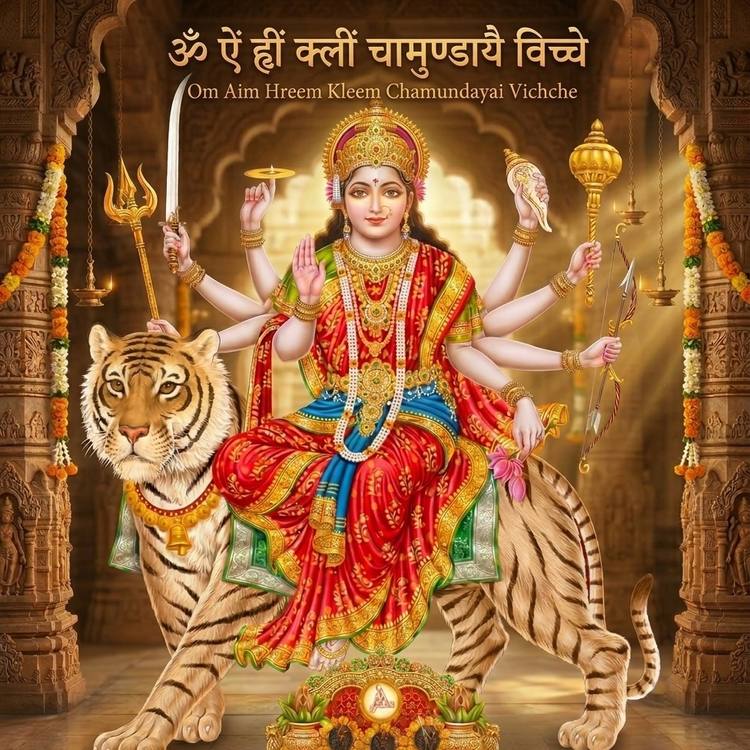
ॐ ऐं ह्रीं क्लीं चामुण्डायै विच्चे
om aim hreem kleem chamundayai vichche
O Divine Mother, who manifests as wisdom (Mahasaraswati), prosperity (Mahalaxmi), and power (Mahakali); O Chamunda, destroyer of negative tendencies, untie the knots of my ignorance and liberate my mind.
Navarna means nine letters — nava, nine, and arna, letter. After Om, the mantra is nine syllables: ऐं ह्रीं क्लीं चा मु ण्डा यै वि च्चे. It holds the three forms of the Mother in three seed syllables, names her as Chamunda, and ends in a single word of prayer.
Six words, one prayer
Read across, the six words are the meaning above, said in the order the mantra says it: the three Mothers, then her name, then what is asked of her.
- ॐOm
The primordial sound with which every mantra opens.
- ऐंAim
The seed of Mahasaraswati — the Mother as wisdom.
- ह्रींHreem
The seed of Mahalakshmi — the Mother as prosperity.
- क्लींKleem
The seed of Mahakali — the Mother as power.
- चामुण्डायैChamundayai
To Chamunda, destroyer of negative tendencies.
- विच्चेVichche
The prayer itself: untie the knots of my ignorance, and liberate my mind.
How to pronounce the Navarna Mantra
Listen to the recording once or twice before you chant along. Each of the three seed syllables closes on a soft hum — the dot written above the letter, the anusvara — rather than on a hard m.
Om
A long, open o closing into a hum — ommm.
Aim
Like the English word I’m, ending on a soft hum.
Hreem
A breathed h straight into reem, the ee held long.
Kleem
Kleem, the ee long, closing on the same hum.
Chamundayai
Chaa-mun-daa-yai: the two long aas carry it.
Vichche
Vich-che: the ch doubled, a small catch before the last syllable.
Where the mantra comes from
The Durga Saptashati — also called the Devi Mahatmya or Chandi Path — is the text of Navratri: seven hundred verses in thirteen chapters, read through the nine nights in temples and homes. The Navarna Mantra is chanted alongside it, and its three seeds follow the text’s own shape. The Saptashati falls into three parts, each presided over by one form of the Mother:
| Part | Chapters | The Mother as | Seed | The story |
|---|---|---|---|---|
| Prathama charitra | Chapter 1 | Mahakali | क्लीं Kleem | Madhu and Kaitabha |
| Madhyama charitra | Chapters 2–4 | Mahalakshmi | ह्रीं Hreem | Mahishasura |
| Uttama charitra | Chapters 5–13 | Mahasaraswati | ऐं Aim | Shumbha and Nishumbha |
Chamunda gets her name in the seventh chapter. Sent against the Devi by Shumbha and Nishumbha, the generals Chanda and Munda are met by a fierce form who springs from her brow; when she lays them both down, the Devi names her Chamunda — she who ended Chanda and Munda. That is the form the mantra addresses: the Mother as the end of what holds the mind in knots.
How to join, and how to chant 108 times a day
108 — one mala — is the standard daily count. Sit at the same hour each day if you can, before the kalash if you have set one up on Ghatasthapana.
-
01
Join
Open mantrarepeater.com on your phone or your computer and open Navratri Sankalp (you will find it under Sankalp). Tap Join. Joining is free and it works in the browser; nothing to install.
-
02
Choose your daily count
Ek Mala is 108 a day. Madhyam is 324, three malas. Purna Anushthana is 1,100. Pick the one you can keep for all ten days rather than the one that sounds best on the first.
-
03
Begin chanting
Press Begin chanting and the mantra starts. It repeats on its own and you do not have to keep count. Sit before the kalash or the Devi’s picture, hold your mala, or simply close your eyes.
-
04
Watch it join everyone's
The big number is everybody’s chanting together; your own count sits quietly beneath it. Shared counting opens on 11 October and closes on the night of 20 October.
108, 324 or 1,100 a day: what each one asks
Three counts, at about six seconds a repetition. Choose for your busiest day, not your first one — a smaller count kept all ten days is a fuller sankalp than a large one dropped on the fourth.
| Sankalp | Each day | Time each day | Over ten days |
|---|---|---|---|
| Ek Mala | 108 | about 11 minutes | 1,080 |
| Madhyam | 324 | about 32 minutes | 3,240 |
| Purna Anushthana | 1,100 | a little under 2 hours | 11,000 |
A single Purna Anushthana, kept all ten days, is 11,000 repetitions — on its own, the size of the whole sankalp’s first milestone.
How to chant the Navarna Mantra: the traditional way to sit
None of this is required to join, and households keep it in their own ways. It is the shape a japa sitting has traditionally had, for anyone who wants it.
-
01
Take the sankalp once
On the first day, before you begin, hold a little water in your right palm and say — aloud or inwardly — your name, the mantra, your daily count and the ten days, and for whom you offer it. Then let the water go. It is said once, and it holds the whole ten days.
-
02
The same seat, the same hour
Before the kalash if you set one up on Ghatasthapana, or before any picture of the Devi. Many people face east or north. Morning or evening sandhya are the traditional hours; the hour you can keep every day is the right one.
-
03
The mala, if you use one
A japa mala has 108 beads and one larger bead, the meru. Turn at the meru and go back the other way rather than crossing it. With the sankalp counting for you, the mala is for the hand and the attention, not for the arithmetic.
-
04
Aloud, whispered, or in the mind
Tradition names three ways: vachika, aloud; upamshu, a whisper only you can hear; and manasika, in the mind alone. Begin aloud with the recording, and let the voice grow quieter as the sitting settles.
-
05
Close, don't just stop
At the end of the count, sit for a minute in the silence the mantra leaves behind, and offer the sitting with folded hands. On the tenth day the whole ten days are offered together.
Navratri 2026, day by day
Shared counting opens at midnight as the first day begins and closes at midnight at the end of the tenth. Every repetition in between goes into one total.
- Day 111 OctSunGhatasthapana · counting opens
- Day 212 OctMon
- Day 313 OctTue
- Day 414 OctWed
- Day 515 OctThu
- Day 616 OctFri
- Day 717 OctSat
- Day 818 OctSun
- Day 919 OctMon
- Day 1020 OctTueVijayadashami · Purnahuti
Which day carries Ashtami and Navami this year differs between almanacs — follow your family’s or your temple’s panchang for those.
Why it is chanted together
Through Navratri the Saptashati is read aloud in temples and homes, often by many voices at once, and the japa is offered on the last day in everyone’s name. This sankalp is the same practice for whoever cannot be in the room: your 108 goes into one shared count, and what is offered at the end is offered for everyone who chanted.
The shared goal climbs in steps. A sankalp kept alone is easy to drop on the fourth day; one you can see other people keeping is not.
- Milestone 111,000
- Milestone 225,000
- Milestone 351,000
- Goal1,11,000
Each milestone opens the next when it is crossed. There is no leaderboard: only everyone’s total, and your own count beneath it.
What happens to the count on the tenth day
On Tuesday, 20 October 2026, Vijayadashami, the sankalp closes with the Purnahuti — the completing offering. The count stops at midnight that night and the final figure stays on the page: not a score, but an arpan, offered at the Mother’s feet by everyone who chanted.
Take the sankalp
About six seconds a repetition, so one mala of 108 is about eleven minutes. Join free at mantrarepeater.com — it runs in your browser, and your count is kept for you and added to everybody else's.
Questions people ask
What is the Navarna Mantra?
The Navarna Mantra is ॐ ऐं ह्रीं क्लीं चामुण्डायै विच्चे — Om Aim Hreem Kleem Chamundayai Vichche. Navarna means nine letters: after Om, the mantra is nine syllables. It is addressed to the Divine Mother as Chamunda and is the mantra chanted alongside the Durga Saptashati through Navratri.
What does the Navarna Mantra mean?
O Divine Mother, who manifests as wisdom (Mahasaraswati), prosperity (Mahalaxmi), and power (Mahakali); O Chamunda, destroyer of negative tendencies, untie the knots of my ignorance and liberate my mind.
What do Aim, Hreem and Kleem mean?
They are seed syllables (bija mantras), each holding one form of the Mother: Aim is Mahasaraswati, the Mother as wisdom; Hreem is Mahalakshmi, the Mother as prosperity; Kleem is Mahakali, the Mother as power.
What does Vichche mean in the Navarna Mantra?
Vichche is the prayer at the end of the mantra: untie the knots of my ignorance, and liberate my mind.
How is the Navarna Mantra connected to the Durga Saptashati?
The Durga Saptashati (Devi Mahatmya) has three parts, each presided over by one form of the Mother — Mahakali (chapter 1), Mahalakshmi (chapters 2–4) and Mahasaraswati (chapters 5–13). The Navarna Mantra holds all three in its seeds, and names the Mother as Chamunda, the form who in chapter 7 ends the demons Chanda and Munda.
When is Navratri 2026?
Sharad Navratri 2026 begins with Ghatasthapana on Sunday, 11 October 2026 and ends with Vijayadashami (Dussehra) on Tuesday, 20 October 2026. The Navratri Sankalp counts across exactly those days, from 11 October to the night of 20 October.
How long does it take to chant the Navarna Mantra 108 times?
About eleven minutes. One repetition runs about six seconds at an unforced pace, so a mala of 108 is roughly eleven minutes, three malas (324) about half an hour, and 1,100 a little under two hours across the day.
Can I chant the Navarna Mantra silently?
Yes. Tradition names three ways of japa: aloud (vachika), in a whisper only you can hear (upamshu), and in the mind (manasika). Many people begin aloud with the recording and let the voice grow quieter as the sitting settles.
Do I need a mala?
No. In the Navratri Sankalp the repetitions are counted for you. If you like to hold a mala, it has 108 beads and a larger meru bead; turn at the meru rather than crossing it.
How do I join the Navratri Sankalp?
Go to mantrarepeater.com on your phone or your computer, open Navratri Sankalp, and tap Join. You can join now; the shared counting opens on 11 October. It runs in the browser — there is nothing to download.
Which daily count should I choose?
Ek Mala is 108 a day, Madhyam is 324 and Purna Anushthana is 1,100. Choose the one you can keep on the busiest of the ten days. A smaller count kept every day is a fuller sankalp than a large one dropped on the fourth.
Do I have to count my own chants?
No. The mantra repeats on its own and every completed repetition is counted for you and added to the shared total.
What if my internet stops while I am chanting?
Keep chanting. Nothing is lost — your repetitions are held on your device and added to the shared total as soon as the signal returns.
What is the Purnahuti?
The Purnahuti is the completing offering that closes a sankalp. The Navratri Sankalp closes with it on Vijayadashami, 20 October 2026, when everyone's count is offered together.
Does it cost anything to join?
No. Joining the Navratri Sankalp is free.
Is anybody ranked or compared?
No. There is no leaderboard and no score. There is everybody's chanting together, and your own count beneath it.