
Ganesh Mantra Sankalp 2026:
Chant Om Gam Ganapataye Namah 108 Times, Together
Ganesh Chaturthi 2026 falls on Monday, 14 September, and Anant Chaturdashi — the day of Ganesh Visarjan — on Friday, 25 September. Across those days: one crore repetitions of the Ganesh mantra ॐ गं गणपतये नमः, chanted by everyone together. Nine seconds a repetition, and you do not have to keep count.
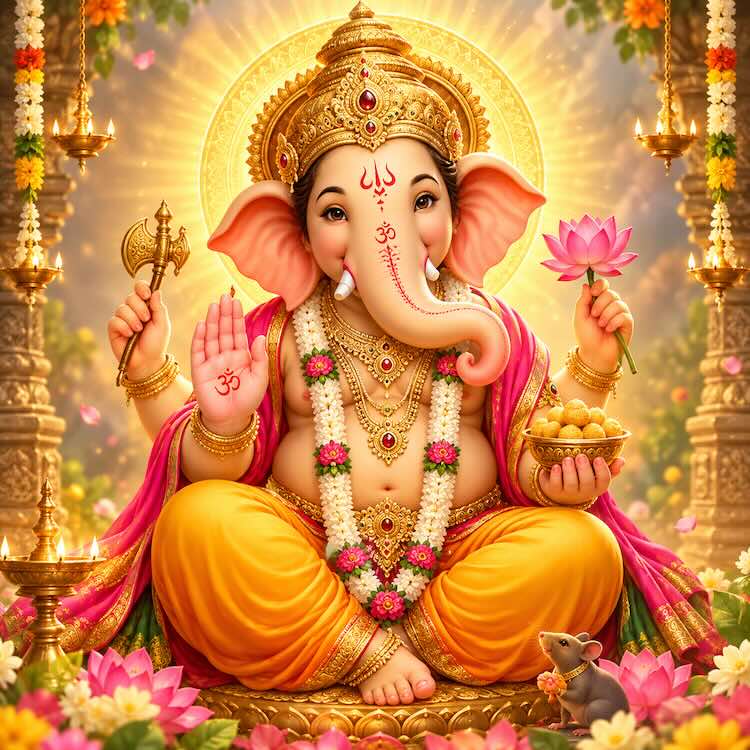
The Ganesh mantra, and why this one
ॐ गं गणपतये नमः
om gam ganapataye namah
Ganesha is invoked before anything begins — a wedding, a shop, a journey, even another god’s puja. His name is taken first, which is why he is called Vighnaharta, the one who clears the way. So this is less a request than a beginning: gam is his bija, his seed syllable, one sound holding the whole of him, and namah is the bow.
A seed syllable is repeated rather than read once, which is exactly what a sankalp of this kind asks for. And this recording runs nine seconds — which is what makes chanting the Ganesh mantra 108 times an ordinary sixteen minutes rather than an afternoon.
How to join, and how to chant 108 times a day
108 — one mala — is the standard daily count, and it is the count this sankalp is built around. Sit at the same hour if you can; before the murti if you have one installed.
-
01
Join
Open mantrarepeater.com on your phone or your computer, go to Sankalp, and open Ganeshotsav Sankalp 2026. Tap Join. That is the whole of it — the screen will say Day 1, and joining is free. It works in the browser; nothing to install.
-
02
Begin chanting
Press Begin chanting and the mantra starts. It repeats on its own — you press nothing between repetitions, and you do not have to keep count. Close your eyes, hold your mala, sit before the murti, or let it play while you are in the kitchen.
-
03
Watch it join everyone's
The big number is everyone's chanting together, written in lakhs and crores. Underneath it, quietly, is your own contribution. There is no ranking and nobody is compared to anybody — it is a practice, not a competition.
-
04
Ask your people in
One tap on Invite friends & family sends it on WhatsApp — to your sister, your son abroad, the building group, your bhajan mandali. A mandal can print the same link as a QR code and put it beside the murti.
Why it is chanted together
You already know why, because you have stood inside it.
The akhand paath
It ran day and night because it was not permitted to stop until it was finished. Nobody in that room was chanting alone.
The Atharvashirsha in the pandal
Mandals across Maharashtra recite the Ganapati Atharvashirsha together, every one of the eleven days. This is the same practice, carried to whoever cannot be in the hall.
The board outside the temple
A crore of the Lord's name will be completed — and the total written up when it was. That number was never anyone's individually.
Nobody in those halls is chanting alone, and nobody’s count belongs only to them. That is the meaning of samuhik japa: your 108 goes into the whole rather than into an account of its own, and what is offered at the end is offered in the name of everyone who chanted. One person, however devoted, cannot produce a crore. Six or seven thousand of us, chanting 108 times a day, can — and that is an ordinary fortnight’s practice, not a feat.
There is a plainer reason too. A sankalp kept alone is easy to abandon on the fourth day; one you can see other people keeping is not. When you open the page in the morning and the number has moved while you were asleep, somebody was chanting through the night.
What happens to the count when he goes
You bring him modak. Durva. A red flower, a lamp. Every one of those is a small thing made large because it was offered. Japa is the same kind of thing — and unlike the flowers it can be counted, which is why the tradition has always counted it: 108 on the mala, a promised number completed before the sankalp is closed.
On Anant Chaturdashi — Friday, 25 September 2026 — the day he is carried out to the water, this count will be complete. What was chanted, by all of us, in his name. Not a score and not an achievement — an arpan, one more thing placed at his feet as he leaves. Ganpati Bappa Morya.
Take the sankalp
Nine seconds a repetition. One mala of 108 is about sixteen minutes. Join free at mantrarepeater.com — it runs in your browser, and your count is kept for you and added to everybody else's.
Questions people ask
What is a sankalp?
A sankalp is the intention you state before a practice begins — what you will do, for how many days, and in whose name. A priest asks for it before a puja or a vrat, traditionally with a little water held in the palm. It is what turns plain repetition into an offering.
When is Ganesh Chaturthi 2026, and when is Ganesh Visarjan?
Ganesh Chaturthi 2026 falls on Monday, 14 September 2026. Anant Chaturdashi — the main day of Ganesh Visarjan, when the murti is carried to the water — is Friday, 25 September 2026. The Ganeshotsav Sankalp runs across those days and closes on 26 September.
What is the Ganesh mantra?
The most widely chanted Ganesh mantra is ॐ गं गणपतये नमः — Om Gam Ganapataye Namah. Gam is Ganesha's bija or seed syllable, and the line means a bow to Ganapati. It is the mantra taken at beginnings, which is why it is chanted through Ganesh Chaturthi.
How do I join the Ganesh Chaturthi sankalp?
Go to mantrarepeater.com on your phone or your computer, open Sankalp, open Ganeshotsav Sankalp 2026, and tap Join. You are in the sankalp from that moment and the screen will say Day 1. It runs in the browser — there is nothing to download.
How long does it take to chant the Ganesh mantra 108 times?
About sixteen minutes. One repetition of Om Gam Ganapataye Namah runs nine seconds, so a full mala of 108 is roughly 16 minutes at an unforced pace. That is the standard daily count for a festival sankalp.
Do I have to count my own chants?
No. The mantra repeats on its own and every completed repetition is counted for you and added to the shared total. You can close your eyes, hold your mala, or let it play while you are in the kitchen.
What if my internet stops while I am chanting?
Keep chanting. Nothing is lost — your repetitions are held on your device and added to the shared total as soon as the signal returns.
Does it cost anything to join?
No. Joining is free, and while you are inside the sankalp your daily chanting limit lifts for this mantra, so you can chant it as long as you wish.
Which Ganesh mantra is chanted for removing obstacles?
Ganesha is addressed as Vighnaharta, the remover of obstacles, and Om Gam Ganapataye Namah is the line traditionally taken before any undertaking for that reason. The Vakratunda Mahakaya shloka and the Sankashtanashana Ganesha Stotram belong to the same tradition. Chanting is an offering, not a transaction — the practice is the point.
Is the Ganesha Atharvashirsha part of this?
The Ganapati Atharvashirsha is what mandals across Maharashtra recite together through the eleven days, and it is the closest traditional parallel to a shared sankalp. This sankalp is set on the short Om Gam Ganapataye Namah so that anybody can keep it; the Atharvashirsha and the Ganesha stotrams are in the Mantra Repeater library to chant alongside it.
Is anybody being ranked or compared?
No. There is no leaderboard and no score. There are two numbers only: everyone's chanting together, and your own quiet contribution beneath it.
Can our mandal or temple run its own sankalp?
Yes — a mandal, a temple or a teacher can run a sankalp with its own mantra, target and window. It is arranged with the Mantra Repeater team rather than set up self-serve, so get in touch and we will open one.